Which Battery is Best for a Solar System in Pakistan?
In Pakistan, rising electricity costs and frequent load-shedding have made solar systems a reliable and affordable energy solution for homes and businesses. But to make your solar setup work efficiently, choosing the right solar battery is very important.
A good solar battery stores extra energy from your panels during the day, so you can use it at night or when the electricity goes out. Without it, your solar system can’t provide backup power, and if you live off-grid, it won’t work at all.
This guide will help you understand which solar battery is best in Pakistan, including the types, prices, performance, and top recommendations for 2026.
Why Solar Batteries Are Important in Pakistan
Solar batteries play a key role in making your solar system truly useful. In Pakistan, many areas face long hours of load-shedding and unstable electricity supply, especially during the summer. With a reliable solar battery, you can store excess solar power and use it whenever needed, ensuring 24/7 access to electricity.
For homes, this means your fans, lights, and appliances keep running even during power cuts. For businesses, it ensures continuous operations without interruptions. A high-quality battery also helps improve system efficiency, saves generator fuel costs, and extends the life of your solar setup.
That’s why choosing the best battery for a solar system in Pakistan is one of the most important decisions for achieving long-term energy independence.
Types of Solar System Batteries in Pakistan
When choosing the best battery for a solar system in Pakistan, it’s important to know the main battery types and how they differ in performance, price, and maintenance. The most common solar batteries used in Pakistan are:
- Flat-plate Lead-Acid Battery
- Tubular Lead-Acid Battery
- Gel Battery
- Lithium-Ion Battery
Each type has its own pros and cons depending on your energy needs and budget.
1. Flat-Plate Lead-Acid Battery
This is the traditional and most affordable solar battery used in Pakistan. It has flat plates submerged in a liquid electrolyte and is suitable for basic solar setups.
Pros:
- Low cost and easily available
- Good for small home solar systems
- Provides decent performance for short-term backup
Cons:
- Needs regular water refilling (maintenance)
- Shorter lifespan, around 400–600 cycles
- Not ideal for heavy or long-term use
2. Tubular Lead-Acid Battery
Tubular batteries are an improved version of lead-acid batteries. They use tubular plates that allow deeper discharge and better durability, making them more suitable for Pakistan’s hot weather.
Pros:
- Long lifespan, around 1,200–1,500 cycles
- Performs well in high temperatures
- Better power backup for homes and offices
Cons:
- Higher price than flat-plate models
- Requires periodic water top-ups
- Heavy and needs proper installation
3. Gel Battery (Sealed Lead-Acid)
Gel batteries are a maintenance-free version of lead-acid batteries. They use a silica gel instead of liquid, which makes them spill-proof and easy to handle.
Pros:
- No need for water refilling
- Spill-proof and safe for indoor use
- Better lifespan than flat-plate types
- Can handle higher temperatures better than other sealed options
Cons:
- Slightly more expensive than flat-plate batteries
- Lower charging efficiency
- Not suitable for very high-load applications
4. Lithium-Ion Battery
Lithium-ion batteries are the latest and most advanced option for solar systems. Though expensive, they offer excellent performance, longer life, and no maintenance.
Pros:
- Very long lifespan over 2,000 cycles
- No maintenance required
- Lightweight and compact design
- High energy efficiency and faster charging
- Works perfectly in all weather conditions
Cons:
- High upfront cost
- Replacement cost can also be high
Solar Battery Comparison in Pakistan (2026)
| Battery Type | Lifespan (Cycles) | Maintenance | Efficiency | Heat Performance | Price (PKR) | Best For |
|---|---|---|---|---|---|---|
| Flat-Plate Lead-Acid | 400–600 | High (regular water) | 70–75% | Moderate | 25,000 – 45,000 | Small solar setups |
| Tubular Lead-Acid | 1,200–1,500 | Moderate | 80–85% | Good | 50,000 – 90,000 | Homes & offices |
| Gel Battery | 800–1,000 | None | 80–85% | Good | 60,000 – 100,000 | Indoor solar systems |
| Lithium-Ion | 2,000–5,000 | None | 95–98% | Excellent | 120,000 – 250,000 | Long-term hybrid setups |
Lithium vs Lead-Acid: Which is Better?
When choosing the best battery for your solar system in Pakistan, the two most common options are lithium-ion and lead-acid batteries. Both types store solar energy effectively, but they differ in price, lifespan, maintenance, and performance. Understanding their differences helps you decide which one fits your home or business needs better, especially in Pakistan’s hot climate and frequent load-shedding conditions.
| Feature | Lithium-Ion Battery | Lead-Acid Battery (Flat/ Tubular/ Gel) |
| Lifespan | 8–12 years (2,000–5,000 cycles) | 3–6 years (400–1,500 cycles) |
| Maintenance | Maintenance-free | Requires regular water refilling (except Gel/AGM) |
| Efficiency | 90–95% energy efficiency | 70–80% energy efficiency |
| Discharge Depth | Up to 90% | 50–60% |
| Charging Speed | Fast charging | Slower charging |
| Temperature Tolerance | Performs well in all climates | May reduce performance in high heat |
| Weight | Lightweight and compact | Heavy and bulky |
| Safety | No gas emission, safe for indoor use | Emits gas; needs ventilation |
| Initial Cost | High upfront cost | Affordable price |
| Overall Value | Long-term savings and higher performance | Budget-friendly but shorter life |
Summary
If you want long life, fast charging, and zero maintenance, go with lithium-ion.
For affordable setups, tubular lead-acid is the best option.
Solar Battery Prices in Pakistan (2026 Update)
| Battery Type | Capacity Example | Average Price Range (PKR) | Key Features |
| Flat-Plate Lead-Acid | 12V / 185Ah | Rs. 40,000 – 65,000 | Low cost, requires regular water filling, shorter life (400–600 cycles). |
| Tubular Lead-Acid | 12V / 200Ah | Rs. 70,000 – 100,000+ | Long life, handles high temperatures, and needs light maintenance. |
| Gel Battery | 12V / 200Ah | Rs. 95,000 – 150,000 | Maintenance-free, safe for indoor use, slightly higher cost. |
| Lithium-Ion (LiFePO₄) | 48V / 100Ah (≈5kWh) | Rs. 185,000 – 300,000+ | High efficiency (90–95%), long lifespan (2000+ cycles), zero maintenance. |
Top Solar Battery Brands in Pakistan (2026)
Here are some reliable brands available in the Pakistani market, along with their approximate prices:
| Brand | Battery Type / Model | Average Price (PKR) | Highlights |
| Livoltek | 51.2V / 100Ah Lithium Battery | ~Rs. 285,000 | High-capacity lithium battery with long lifespan. |
| Knox | 25.6V / 100Ah Lithium Battery | ~Rs. 129,000 | Affordable lithium option for homes and offices. |
| Soluna | 51.2V / 100Ah Lithium Battery | ~Rs. 270,000 | Premium lithium battery with fast charging. |
| Atlas | 12V / 100Ah Lead-Acid Battery | ~Rs. 12,500 | Budget-friendly lead-acid battery for small setups. |
| Pylontech | LiFePO₄ Lithium Battery | Rs. 125,000 – 245,000 | Efficient and durable storage for large systems. |
Which Solar Battery Offers the Best Value?
- If you’re on a budget, go for tubular lead-acid batteries. They’re affordable, reliable, and perform well in Pakistan’s hot climate.
- For maintenance-free performance and longer life, lithium-ion batteries are the best; though they cost more initially, they save money in the long run.
- Gel batteries are ideal for people who prefer a safe indoor option with zero maintenance.
Why Solar Batteries Are Important for Homes
1. Backup Power During Load-Shedding
Frequent power cuts are common in Pakistan. A solar battery ensures your fans, lights, and essential appliances keep running when the grid goes down.
2. Energy Independence
With a solar system for home use, you don’t have to rely completely on the national grid. You generate and store your own energy.
3. Save Money on Electricity Bills
By using the energy stored in your solar battery, you can reduce your monthly electricity expenses.
4. Environment-Friendly Power
Solar batteries for home use in Pakistan promote clean and green energy. They help reduce pollution and make your home eco-friendly.
5. Reliable Power Anytime
Even at night or during cloudy weather, your solar system battery makes sure you always have electricity available.
6. Long-Term Investment
Although solar batteries, especially lithium-ion batteries, can be costly at first, they offer better performance and last longer, saving you money over time.
Best Battery Options for Different Home Sizes
| Home Type | System Size | Recommended Battery Type | Notes |
| Small Homes | 1–2 kW | Lead-Acid or AGM Battery | Affordable and suitable for basic needs |
| Medium Homes | 3–5 kW | Gel or Lithium-Ion Battery | Balance of cost, performance, and durability |
| Large Homes / Commercial Use | 5–10 kW+ | Lithium-Ion Battery | Best for long backup and low maintenance |
If you want reliable power during load-shedding and less maintenance, go for a lithium-ion solar battery. It may cost more in the beginning, but it performs better, lasts longer, and saves you money in the long run.
How Solar Batteries Work in a Solar System
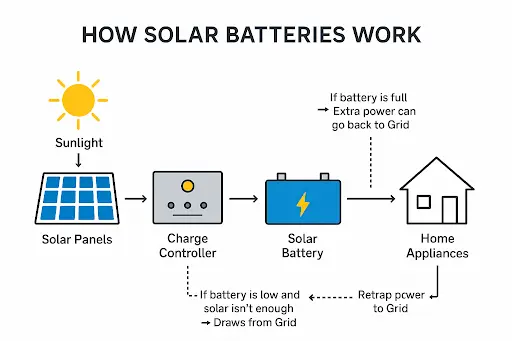
Step-by-Step Working Process
1. Solar panels produce electricity
Sunlight hits your solar panels and they make DC electricity.
2. Power is used by the home first
When panels are producing, your home uses that power right away for lights, fans, etc.
3. Extra power charges the battery
If panels make more power than you need, the extra energy goes into the solar battery for later use.
4. Charge controller protects the battery
A charge controller watches charging to stop overcharging and protect battery life.
5. Battery stores energy for later
The solar battery keeps this stored energy so you can use it at night or during load-shedding.
6. The inverter converts stored power for appliances
When you need power from the battery, the inverter changes DC from the battery into AC for home appliances.
7. Grid interaction (if connected)
If the battery is full, extra power can be sent to the grid.
If the battery is low and solar isn’t enough, the system can draw from the grid.
Important Things to Know Before Buying a Solar Battery
A good battery can make your system more efficient, provide longer backup, and save you money in the long run. Before you buy, it’s important to understand what factors matter most.
Here are some key points to consider when selecting the best battery for your solar system in Pakistan
1. Battery Capacity (Storage Power)
The capacity of a solar battery tells you how much energy it can store. It’s usually measured in kilowatt-hours (kWh).
- For small homes, 2–5 kWh batteries work fine.
- For larger homes or offices, go for 10 kWh or more.
A higher-capacity battery provides longer backup during load-shedding or cloudy days.
2. Battery Type
There are several solar system battery types, including lead-acid, gel, AGM, and lithium-ion.
- Lead-acid batteries are cheaper but need regular maintenance.
- Lithium-ion batteries cost more but last longer and require no maintenance.
Choose the type that fits your budget and usage needs.
3. Battery Lifespan (Cycle Life)
Each battery has a limited number of charge and discharge cycles.
- Lead-acid batteries usually last around 2–4 years.
- Lithium-ion batteries can last 10–15 years or more.
A battery with a longer life cycle will save you replacement costs in the future.
4. Efficiency and Performance
High-efficiency batteries store and deliver more usable energy.
Lithium-ion solar batteries are known for their efficiency (90–95%), while lead-acid batteries offer lower efficiency (70–80%).
For maximum output from your solar system in Pakistan, go for a battery with higher efficiency.
5. Weather Compatibility
Pakistan’s hot weather affects battery performance.
Choose a battery that can handle high temperatures without losing capacity.
Tubular and lithium-ion batteries perform best in such conditions.
6. Budget and Long-Term Cost
While lead-acid solar batteries are cheaper initially, they require frequent maintenance and earlier replacement.
Lithium-ion batteries have a higher upfront cost but save money in the long run due to their durability and low maintenance.
7. Warranty and Brand Reliability
Always check the warranty period and brand reputation before buying.
Reputable brands offer 5–10 years warranty, ensuring product reliability and after-sales support.
Conclusion
When choosing the best battery for a solar system in Pakistan, always consider your usage, local temperature, and budget. While lead-acid batteries are great for short-term affordability, lithium-ion batteries deliver better efficiency, faster charging, and a much longer lifespan.
For 2026 and beyond, investing in a lithium-ion solar battery is the smartest choice for homeowners and businesses looking for long-term energy independence in Pakistan.
11. Frequently Asked Questions (FAQs)
Q1: How long does a solar battery last in Pakistan?
A good lithium-ion battery lasts 10–15 years, while lead-acid types last around 3–5 years.
Q2: What is the price of a solar battery in Pakistan in 2026?
Prices range from Rs. 40,000 for lead-acid batteries to Rs. 300,000+ for lithium-ion batteries.
Q3: Which battery is best for homes in Pakistan?
For small homes, tubular lead-acid batteries are ideal. For larger homes or offices, lithium-ion batteries are the best choice.
Q4: Do solar batteries need maintenance?
Lithium and gel batteries are maintenance-free. Flat-plate and tubular lead-acid batteries need regular water refilling.
Q5: Can a solar system work without a battery?
Yes, but it won’t provide backup during load-shedding. A battery is essential for a 24/7 power supply.